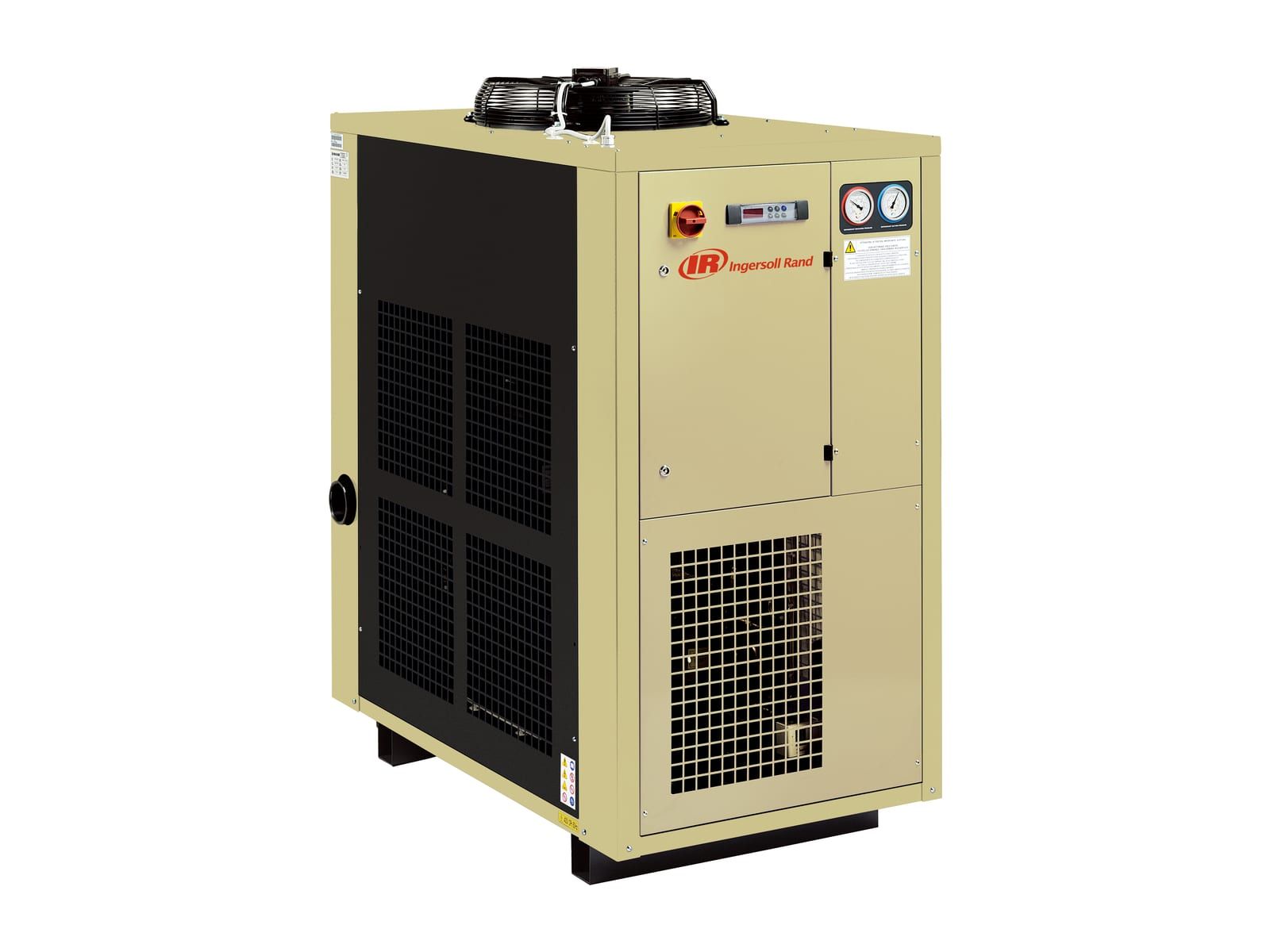
Take the water out before it reaches the pipe
Compressed air leaves the compressor saturated with water vapour. As it cools in the pipework, that vapour condenses into liquid water that corrodes pipes, washes out lubrication and spoils finishes. A refrigerated dryer cools the air deliberately, in a controlled place, so the water condenses and drains away before it reaches the network.
We supply refrigerated dryers from the brands we represent. Ask us which series are currently supplied in Cambodia.
How it works
Warm, wet air first passes through an air-to-air heat exchanger, where it is pre-cooled by the cold, dry air leaving the dryer. It then passes through an evaporator cooled by a refrigeration circuit, which brings it down to a few degrees above freezing. Water condenses, is separated and is discharged through a drain. The cold, dry air returns through the air-to-air exchanger, picking up heat so that it leaves warm enough not to sweat on the outside of pipes.
The result is a pressure dew point of around +3 °C, which is water Class 4 under ISO 8573-1:2010. As long as no pipe runs colder than that, no more water condenses in the network.
Where it fits
- General plant air for tools, machines, blow-off and actuators.
- Most garment, packaging, assembly and processing lines.
- As a first stage ahead of point-of-use desiccant dryers for the few users that need drier air.
Where you need a lower dew point, or air lines pass through cold areas, see desiccant dryers.
Selection notes
- Correct for site conditions. Capacity is published at reference inlet and ambient temperatures. A Cambodian compressor room in the hot season is often hotter, and the corrected capacity can be much lower. We apply the manufacturer’s correction factors before sizing.
- Give it cool air. Air-cooled refrigeration needs fresh, cool air around the condenser. A dryer in the compressor’s hot exhaust loses performance.
- Drains matter. A failed drain floods the separator and sends water downstream. Use a zero-loss drain and check it.
- Pressure drop. Choose sizes that keep pressure drop low, because it is paid for at the compressor.
What Nexus provides
Sizing with corrected capacities, placement and ventilation design, installation, dew-point verification at commissioning, and planned maintenance: condenser cleaning, drain checks and refrigerant circuit checks.