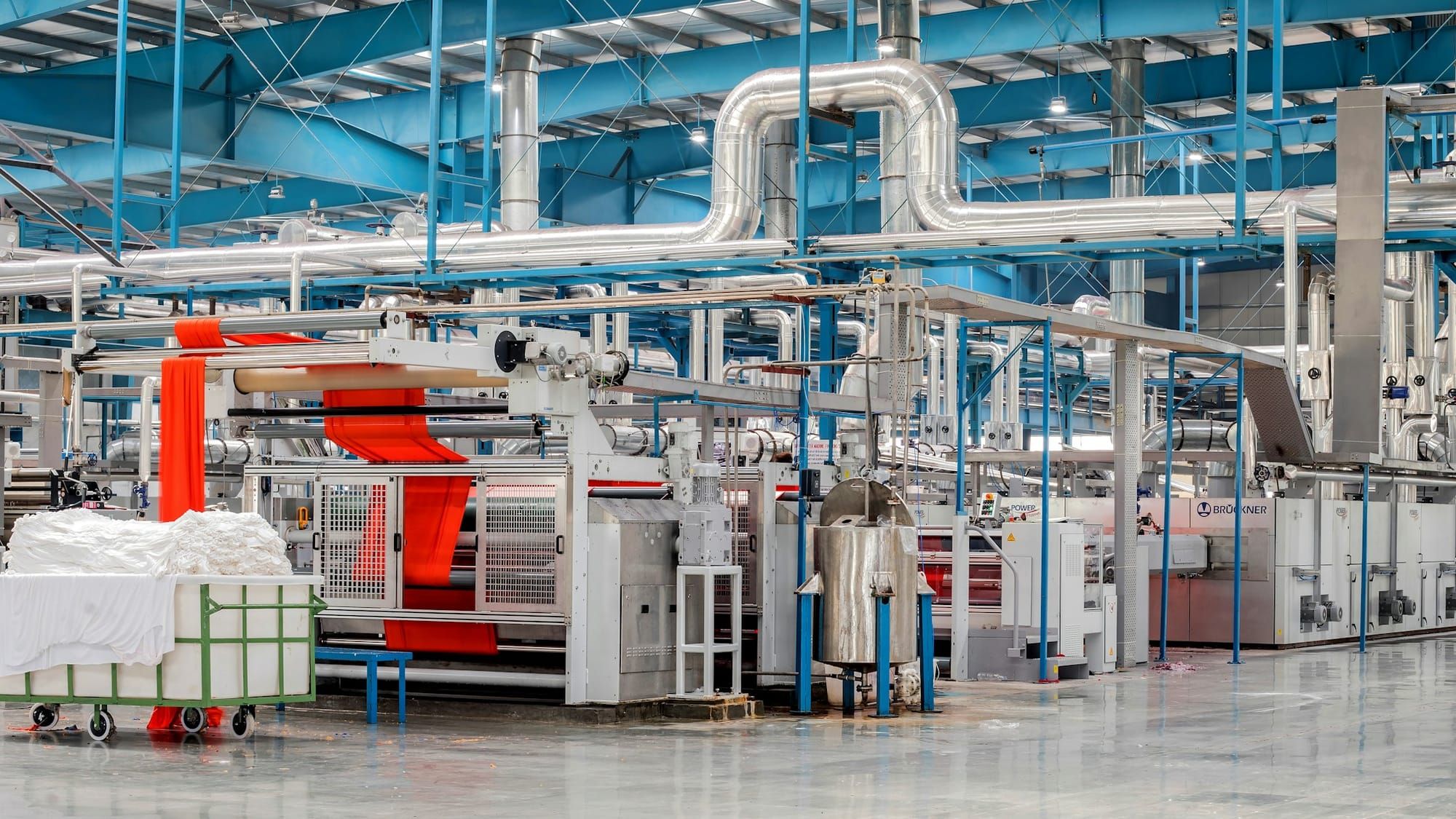
The challenge: many small users, and a fabric that shows everything
Compressed air in a garment factory is spread thin. Hundreds of sewing stations, thread trimmers, pressing tables, spot-cleaning guns, blow-off points and packing lines each take a little air. Few of them need high pressure. Almost all of them touch fabric, or sit close to it.
That has three consequences. First, the system has hundreds of hoses and quick connections, so leaks grow quietly from month to month. Second, oil or water that reaches the point of use leaves a mark that turns a finished garment into a reject. Third, demand follows the shift pattern closely. Lines stop for breaks, at night and on rest days, while the compressors often keep running against leaks.
The building works against you too. Phnom Penh’s climate means hot, humid intake air for most of the year. Compressor rooms recirculate their own heat if ventilation was an afterthought. Dryers sized on a temperate datasheet run short of capacity. Fabric stores and finished-goods warehouses take on moisture through the monsoon, and cutting and sewing fill the air with lint that blocks filters and coolers.
The air services a garment plant needs
Compressed air, sized to the shift
The starting point is the demand profile, not the nameplate. We log flow and pressure across production, breaks and stoppages, then size the hall in layers. A base-load compressor carries the steady demand, and a variable-speed trim compressor follows the swings. A sequencer runs the fleet as one machine. Garment plants rarely need high line pressure, so we design for the lowest stable pressure the stations accept, and fix restrictions before anyone raises a setpoint. See compressed air systems and the air compressors we supply.
A looped ring main with drops taken from the top of the header keeps pressure even across a long sewing hall and keeps condensate out of the hoses. Sectional isolation lets you shut down an idle line at night.
Treatment that protects the fabric
Air treatment is where stains are prevented. A typical train is an aftercooler and separator, a refrigerated dryer sized for tropical inlet temperatures, and staged particulate and coalescing filters. Every low point gets a zero-loss drain, and condensate from oil-injected machines goes through an oil-water separator before discharge. We write the target purity as an ISO 8573-1 class at the point of use, so it can be tested later. Browse air treatment.
Humidity control for fabric and finished goods
Cotton, trims and cartons absorb moisture. In closed, unconditioned stores through the monsoon, that leads to mould, odour, weakened cartons and shipment complaints. We size industrial dehumidifiers to the room volume, infiltration and moisture load, and hold relative humidity at the target your quality team sets. Our humidity control work starts with sealing and door discipline, because a dehumidifier cannot dry the whole outdoors.
Lint, heat and the production floor
Lint loads supply-air filters, coils and compressor coolers, so filter selection and change intervals matter. We specify panel and pocket filters and media by ISO 16890 class and plan access for cleaning. For hot halls, ventilation, evaporative cooling or HVAC and cooling are designed against the heat load and the number of people on the floor. Where garments are screen printed or heat-transfer printed on site, solvent fumes may also need air quality and emissions control.
Visibility
Metering the hall makes waste visible. A flow meter, a power meter and a dew-point sensor give you kWh/m³, off-production demand and air dryness on one screen. That is the basis of energy optimisation.
The most useful number in a garment plant is the compressor load when every line has stopped.
Standards that apply
Energy work follows the assessment method of ISO 11011. Ventilation filters are classified under ISO 16890, which replaced EN 779. If your buyers audit social compliance or product quality, we provide the technical records your team needs: purity class, dew point and maintenance logs. We don’t certify the plant.
Typical scope
| Package | What it usually includes |
|---|---|
| Survey and baseline | Demand logging across shifts, leak survey, dew point and pressure profile |
| Generation | Base-load and variable-speed compressors, sequencer, N+1 standby |
| Treatment | Aftercooler, refrigerated dryer, staged filtration, zero-loss drains |
| Distribution | Looped ring main, top-entry drops, sectional isolation |
| Stores and floor | Dehumidifiers for fabric and finished goods, lint filtration, ventilation |
| Support | Maintenance contract, leak programme, data reviews |
Savings are project-specific. We measure them against a baseline and verify them after implementation; we don’t promise a blanket percentage.
Start with an air audit or a leak detection survey, then size the fix. To see what a leak programme could be worth on your tariff, try the leak cost calculator.