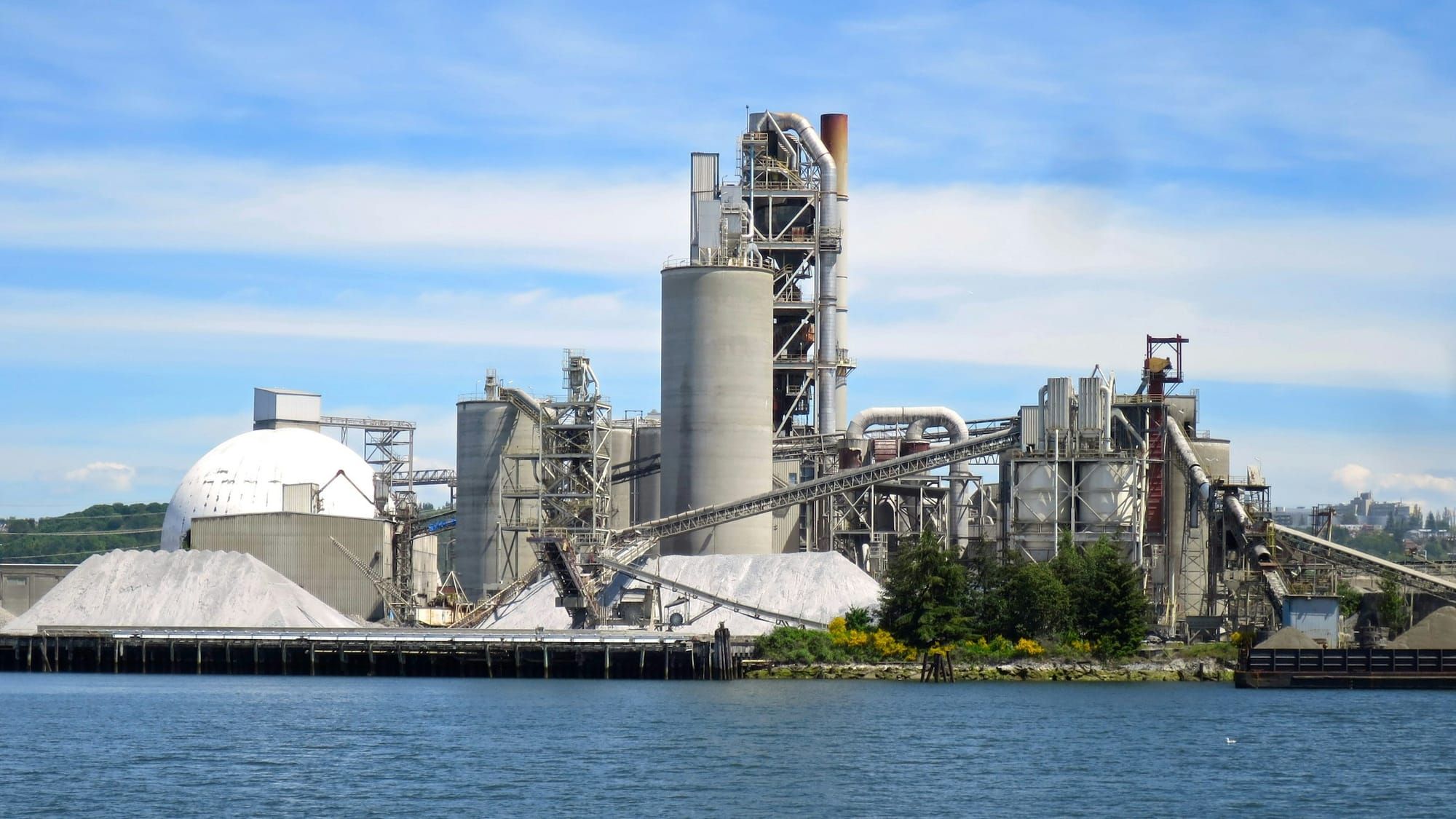
The challenge: dust, heat and loads that never stop
Cement and building-materials plants use more air than their owners tend to think. Compressed air cleans bag filters with short pulses, drives packing machines, conveys powder in dense phase, unloads bulk tankers and keeps instrument-air dampers and gates moving. Low-pressure air from blowers fluidises silos, conveys raw meal and cement in dilute phase, and feeds burners and dryers. Dust collection, finally, sits on almost every transfer point.
All of it runs in dust and heat. Dust clogs compressor intake filters, coats oil coolers and aftercoolers, and wears blower lobes and bearings. In a tropical climate the compressor room starts hot before it adds its own heat. Fouled coolers then push discharge temperatures up until machines trip, usually at the worst moment in the production day. Pulse air carrying water wets bags and cakes dust on them. Differential pressure across the collector then climbs, fans lose airflow and emissions rise.
Power quality is the other constant. Large motors starting on a weak supply cause voltage dips that can drop compressors and blowers off line. Drives, soft starters and restart logic need to be designed with the site’s supply in mind.
The air services a cement plant needs
Compressed air built for dust
We start with the compressor room, because it decides reliability. Intake air is drawn from a clean, shaded point through a filter sized for the dust. Cooling air is ducted in and hot air ducted out, so the room never breathes its own exhaust. Our article on compressor room design for tropical heat covers the rules. Generation is split into base-load and trim machines with N+1 standby. A sequencer runs them as one hall. See compressed air systems and air compressors.
Treatment is simple but disciplined. An aftercooler, a refrigerated dryer corrected for tropical inlet temperatures, particulate filtration and reliable zero-loss drains keep pulse and instrument air dry. Local receivers beside large collectors stop pulse cleaning from pulling down plant pressure. Browse air treatment.
Blowers for conveying and aeration
Dilute-phase conveying, silo fluidising and combustion air are low-pressure duties. Producing that air at full compressed-air pressure and throttling it wastes energy. Roots blowers and screw blowers deliver it directly. We select by pressure, flow, duty cycle and the dust the blower will breathe. Compare types in roots vs screw vs turbo blowers and browse blowers.
Dust collection on every transfer point
Crushers, mills, separators, elevators, silos and packers each need extraction sized to the hood, the dust and the temperature. Cartridge collectors suit packing and grinding units. A baghouse suits large volumes. A cyclone separator takes the coarse fraction off hot or abrasive streams first. We design ducting velocities that keep dust airborne, and specify differential-pressure monitoring on each collector. Fans are selected for the system resistance with dirty filters, not clean ones, so extraction holds up between bag changes. Where collected dust can go back into the process, as with cement and raw meal, we arrange the discharge to return it. See air quality and emissions and our article on dust collection for cement, rice and feed mills.
Electrical and control rooms
Drives, PLCs and switchgear fail early in dust and heat. Cooled, filtered and slightly positive-pressure electrical rooms keep dust out. We size HVAC and chillers and select supply-air filters by ISO 16890 class.
Monitoring
Pressure at the collectors, compressor and blower power, dew point and collector differential pressure on one screen show a problem before it stops a mill. See SCADA and monitoring.
In a cement plant, the compressor room is the first piece of dust control.
Standards and limits that apply
Emission limits for stacks and fugitive dust come from your environmental permit, not from us. We design to them and provide the design basis. Energy work follows ISO 11011, and supply-air filters for electrical rooms are classified under ISO 16890.
Typical scope
| Package | What it usually includes |
|---|---|
| Survey | Air-user list, demand logging, collector differential pressures, room temperatures |
| Compressor room | Filtered intake, ducted ventilation, base and trim machines, N+1 |
| Treatment and storage | Aftercooler, dryer, drains, local receivers at collectors |
| Low-pressure air | Roots or screw blowers for conveying, aeration and combustion air |
| Dust collection | Cartridge, baghouse or cyclone per point; ducting; monitoring |
| Support | Spare parts on site, maintenance contract, filter and bag programme |
Low-pressure and pulse loads are where energy hides. The pressure reduction savings tool shows what a lower setpoint can be worth. Savings are project-specific. We measure them against a baseline and verify them after implementation; we don’t promise a blanket percentage. Start with an air audit, and keep critical spare parts on site.